
Dr. W. Edwards Deming offered 14 key principles for management to follow to improve the effectiveness of a business or organization significantly. The principles (points) were first presented in his book Out of the Crisis. Below is the condensation of the 14 Points for Management, but these alone will not improve your business.
As noted by Dr. Deming in The New Economics, "My 14 Points for Management follow naturally as application of the System of Profound Knowledge for transformation from the present style of management to one of optimization."
To learn more about Dr. Deming's philosophy and how the 14 Points for Management can be meaningfully implemented, check out DemingNEXT - the new online learning platform for those new to Deming or veterans seeking to deepen their understanding.
Looking for more in-depth understanding of Deming's 14 Points, System of Profound Knowledge, or other aspects of Dr. Deming's philosophy? DemingNEXT has all the answers!

1. Create constancy of purpose toward improvement of product and service, with the aim to become competitive and to stay in business, and to provide jobs.
2. Adopt the new philosophy. We are in a new economic age. Western management must awaken to the challenge, must learn their responsibilities, and take on leadership for change.
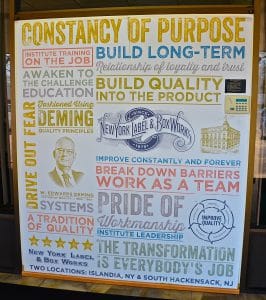 3. Cease dependence on inspection to achieve quality. Eliminate the need for inspection on a mass basis by building quality into the product in the first place.
4. End the practice of awarding business on the basis of price tag. Instead, minimize total cost. Move toward a single supplier for any one item, on a long-term relationship of loyalty and trust.
5. Improve constantly and forever the system of production and service, to improve quality and productivity, and thus constantly decrease costs.
6. Institute training on the job.
7. Institute leadership. The aim of supervision should be to help people and machines and gadgets to do a better job. Supervision of management is in need of overhaul, as well as supervision of production workers.
8. Drive out fear, so that everyone may work effectively for the company.
9. Break down barriers between departments. People in research, design, sales, and production must work as a team, to foresee problems of production and in use that may be encountered with the product or service.
10. Eliminate slogans, exhortations, and targets for the work force asking for zero defects and new levels of productivity. Such exhortations only create adversarial relationships, as the bulk of the causes of low quality and low productivity belong to the system and thus lie beyond the power of the work force.
11a. Eliminate work standards (quotas) on the factory floor. Substitute leadership.
11b. Eliminate management by objective. Eliminate management by numbers, numerical goals. Substitute leadership.
12a. Remove barriers that rob the hourly worker of his right to pride of workmanship. The responsibility of supervisors must be changed from sheer numbers to quality.
12b. Remove barriers that rob people in management and in engineering of their right to pride of workmanship. This means, inter alia, abolishment of the annual or merit rating and of management by objective.
13. Institute a vigorous program of education and self-improvement.
14. Put everybody in the company to work to accomplish the transformation. The transformation is everybody's job.
Deming, W. Edwards. Out of The Crisis (MIT Press) (pp. 23-24)
DOWNLOAD A PDF OF THE 14 POINTS TO SHARE!
Explore More - Videos
Explore More - Podcasts
 The Courage to Not React (March 2, 2026)
 The Courage to Not React (March 2, 2026)
What do you do when a new data point drops—and all eyes turn to you? In this episode, educator John Dues and host Andrew Stotz explore the leadership discipline required when performance data changes. Instead of reacting to a single data point, they unpack how Deming thinking (understanding variation, avoiding tampering, and pausing to interpret patterns) can protect trust, stability, and improvement. A practical conversation for leaders who want wisdom—not speed—to guide their decisions.
Fitness Matters: A Deming Success Story (Part 1) (January 12, 2026)
 Fitness Matters: A Deming Success Story (Part 1) (January 12, 2026)
CEO Travis Timmons shares with host Andrew Stotz how a decade of frustration running his physical therapy practice turned into joy once he discovered Deming’s philosophy and embraced systems thinking. Through PDSA cycles, clearer processes, and genuine team involvement, he transformed Fitness Matters from chaotic growth to a scalable organization getting stellar outcomes. His story shows how small businesses can create stability, joy in work, and remarkable results by improving the system rather than pushing harder.
Where is Quality Really Made? An Insider's View of Deming's World (January 26, 2026)

Bill Scherkenbach, one of W. Edwards Deming’s closest protégés, and host Andrew Stotz discuss why leadership decisions shape outcomes far more than frontline effort. Bill draws on decades of firsthand experience with Deming and with businesses across industries. Through vivid stories and practical insights, the conversation challenges leaders and learners alike to rethink responsibility, decision-making, and what it truly takes to build lasting quality.
When is Change An Improvement? (December 29, 2025)
 When is Change An Improvement? (December 29, 2025)
How do we really know when improvement has happened inside a school or organization? In this episode, John Dues and Andrew Stotz unpack a clear, three-part definition of improvement and show why evidence, method, and sustained results matter far more than year-to-year comparisons. Their discussion offers a practical lens for leaders who want to distinguish true progress from noise and build changes that last.
 Interview with Don Berwick, Co-Founder of Institute for Healthcare Improvement (June 2019)
 Interview with Don Berwick, Co-Founder of Institute for Healthcare Improvement (June 2019)
Dr. Berwick discusses Point 3 of Deming's 14 Points for Management: Cease dependence on inspection to achieve quality. In a series of painful lessons over a number of years, Dr. Berwick learned about Deming's leadership philosophy and began to apply it in healthcare. The results were dramatically better than expected.